Key Takeaways
- Movement during flights may help support circulation: Stretching and light exercises are commonly recommended during long periods of sitting.
- Simple seated movements can be done while flying: Ankle rolls, calf raises, leg lifts, and shoulder stretches are common in-flight exercises.
- Long flights may contribute to stiffness and discomfort: Sitting for extended periods can affect mobility and overall comfort while traveling.
- Hydration and movement are often emphasized together: Drinking water and periodically walking the aisle are commonly suggested during air travel.
- Travel-friendly movement routines require little space: Many airplane exercises are designed to be performed from a seat or a small area.
Flying, as you well know, can land you on the doorstep of loved ones and adventure.
Unfortunately, it can also deliver discomfort — achy legs, stiff lower back — and sometimes lead to medical problems. That’s because when you’re stuck in a small space for an extended period of time, your circulation takes a hit.
Common Symptoms of Poor Circulation
- Numbness or tingling in your legs or glutes
- Tightness, pain, or throbbing in your legs
- Swelling in your lower legs and ankles
- Cramps in your legs, glutes, or feet
Leg pain and swelling can point to more than poor circulation. Both symptoms can indicate deep vein thrombosis (DVT), a blood clot that, in serious cases, can travel to the blood vessels in your lungs, causing a pulmonary embolism (PE).
Being immobile for more than four hours increases your risk of DVT, along with other factors. Flights longer than eight hours pose the greatest risk.
Almost makes you want to stay home.
But you can head off poor circulation and potential medical issues by being proactive.
In-Flight Airplane Exercises
It’s hard to move around when you’re bound to a seat and aisle. But it’s doable, and your body will thank you.
“I’ve counseled countless professional athletes on preventing injuries and managing their bodies during long flights,” says Lisa Chase, PT, an orthopedic and sports physical therapist in St. Petersburg, Florida. “Movement is essential for maintaining healthy circulation.”
Chase was the primary health care provider for the International Tennis Federation at the 2004 Olympics in Athens, Greece. She also spent a decade as the director of sport sciences and medicine for the Women’s Tennis Association (WTA) Tour, which meant traveling to national and international tennis events, including Wimbledon and the Australian, French, and U.S. Open tournaments.
“Moving every 30 to 60 minutes can make a big difference,” Chase says. “It helps prevent cramps, swelling, and other common in-flight discomforts.”
Seated Exercises to Keep Your Blood Flowing
Ankle Pumps
Flex and point your toes and feet multiple times.
“This helps stimulate circulation in the lower legs, reducing stiffness,” Chase says.
Seated March
Lift each knee toward your chest as if you’re marching in place.
“This engages your hip flexors and thighs, promoting blood flow and gentle muscle activation,” Chase says.
Neck and Shoulder Rolls
Slowly roll your shoulders forward and backward, and tilt your head side to side.
“Flights can often cause upper body tension, and these movements ease tightness,” Chase says.
Glute clench
Simply shifting around in your seat can help with circulation, the American Society of Hematology notes. Squeeze and release the muscles in your rear end to create even more action.
Standing Exercises to Keep Your Blood Flowing
Calf raises
Stand near a stable surface (a seat back, door, or the bathroom sink works) and rise onto your toes, holding briefly before lowering your heels.
“Calf raises encourage blood flow back up from your lower legs,” Chase says.
Front-of-hip stretch
Step one foot behind you, keeping its leg straight, and then slightly bend your front knee while gently tucking and then lifting your hips forward, until you feel a stretch along the front hip of your straight leg. Switch legs.
“This counters tightness from prolonged sitting,” Chase says.
Hamstring stretches
Place one foot slightly in front of you while keeping the leg straight, and then bend forward at your hips. Switch legs.
“This reduces tightness in the back of your legs,” Chase says.
Walk
If you can make your way to the aisle, walking is a great option, one that involves engagement and release throughout your body.
Align Your Spine
Airplane seats are not designed to encourage good posture. A uniform seat is supposed to accommodate all body types, and that’s not realistic.
If you’re short, you might find the headrest forces your head to jut forward, misaligning your cervical spine. If you’re tall, your head might lack support.
The seat’s tilt also might force you to slump into your lower back. Place a rolled blanket, sweater, or jacket behind you to encourage good posture. Where you place the roll depends on your body and its size in relation to the seat, but you’re looking to maintain your spine’s natural curves.
Release Your Soles
Put a small rubbery ball in your sock and roll your foot over it. It will hydrate your connective tissue and help massage your fascia, creating release all the way up your body.
In particular, your calves and feet won’t be as tight, Chase says.
Stay Hydrated
“To support circulation and recovery, stay hydrated before, during, and after your flight,” Chase advises. “Consider adding electrolytes.”
It’s fine to keep it simple and drink water, though. Bear in mind that alcohol will dehydrate, not hydrate, you.
Post-Flight
Walk
Caring for yourself after you land is useful, too.
“When you arrive, go for a 20- to 30-minute walk to help your body adjust, reduce stiffness and re-energize,” Chase says.
Raise your legs
When you hit your final destination, lie back and lift your legs, resting your heels on a wall. This reduces swelling in your lower extremities.
It also feels good and ushers you into relaxation, plus helps you sleep, which is especially helpful if you’re adjusting to a new time zone.
References:
- American Society of Hematology. (n.d.). Blood clots and travel. https://www.hematology.org/education/patients/blood-clots/travel
- Centers for Disease Control and Prevention. (n.d.). Blood clots: Travel risk factors. U.S. Department of Health and Human Services. https://www.cdc.gov/blood-clots/risk-factors/travel.html
- MedlinePlus. (n.d.). Normal spinal curves. A.D.A.M. Medical Encyclopedia. U.S. National Library of Medicine. https://medlineplus.gov/ency/imagepages/19463.htm
DISCLAIMER:
These statements have not been approved by the Food and Drug Administration. These products are not intended to diagnose, treat, cure, or prevent disease.


























































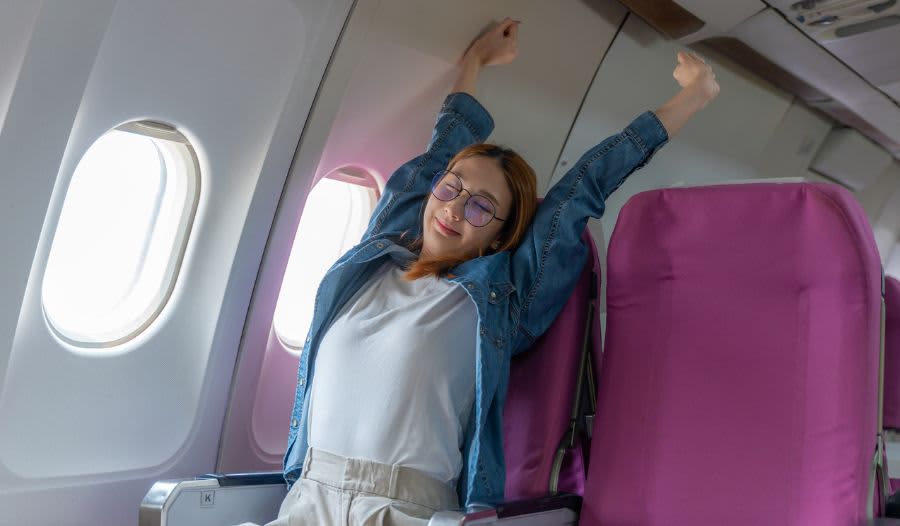
 Table of Contents